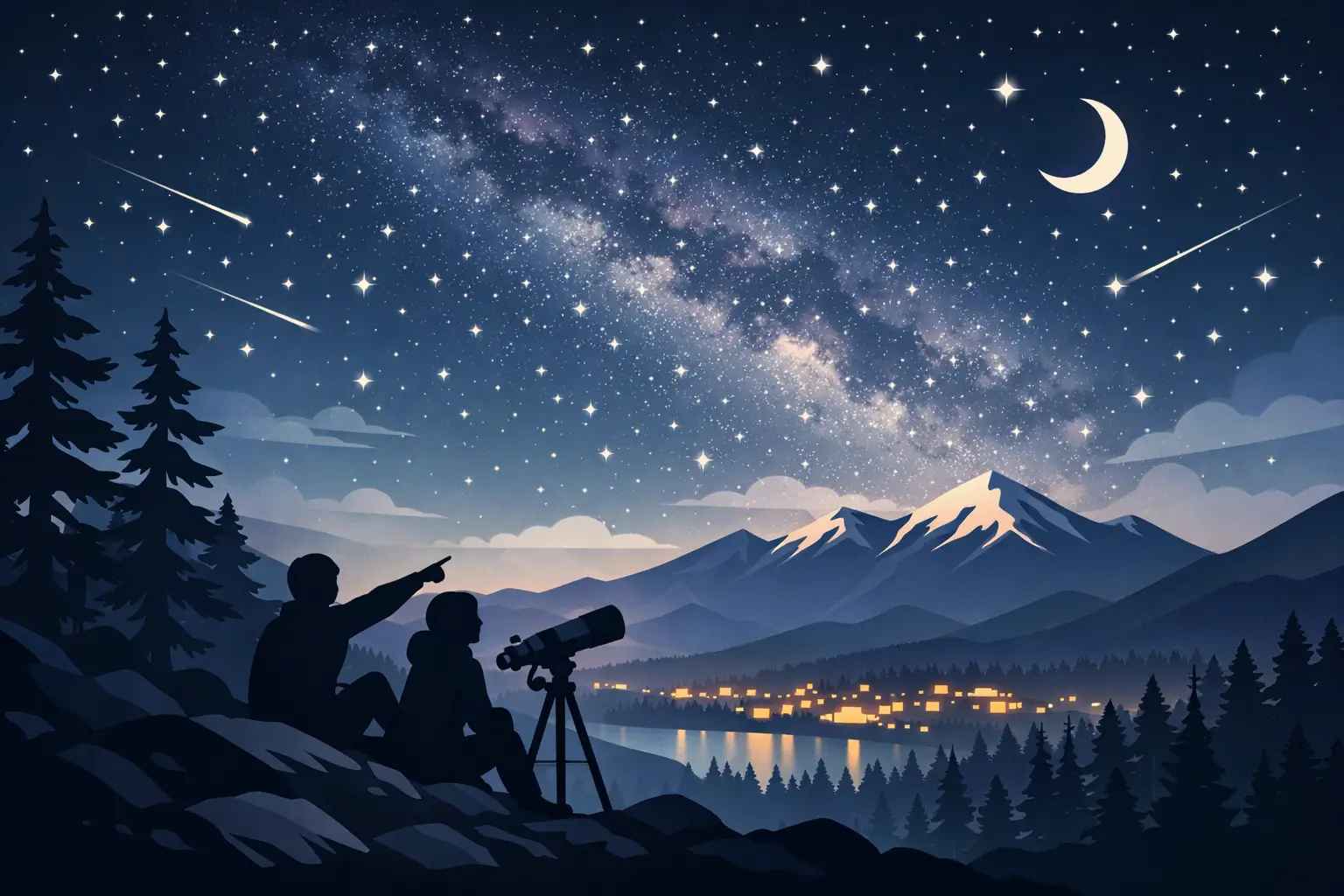
A Flagstaff night can change fast after sunset. The pines go still, the temperature drops, and a sky that looked merely blue an hour ago fills with more stars than many travelers have seen in years. The best stargazing near Flagstaff is not always the farthest point on the map. It is the place where you can settle in safely, give your eyes time to adjust, and look up without rushing back down a rough road.
Flagstaff sits at nearly 7,000 feet, surrounded by high desert, ponderosa forest, and open volcanic country. It is also famous for protecting its night skies. That combination makes it an easy place to build a dark-sky evening into an RV trip, whether you want an observatory program, a quick constellation check after dinner, or a proper late-night session beneath the Milky Way.
Start with the kind of night you want
There is a difference between seeing stars and spending an evening under them. If you are traveling with kids, arriving after a long drive, or just want an easy first look, stay close to town. If your goal is a wider horizon and deeper darkness, head out only after you have checked conditions, fuel, and road access.
A clear forecast matters, but moonlight matters too. Around a new moon, the Milky Way and faint star fields are easier to see. A bright full moon is still beautiful for a walk, a campground fire, or picking out major constellations, but it washes out the fainter details. Summer monsoons can bring dramatic clouds and lightning, while winter skies are often crisp and clear but demand serious layers.
The good news: Flagstaff makes both styles of stargazing possible.
Best stargazing near Flagstaff: five places worth the drive
Lowell Observatory for guided sky time
For many visitors, Lowell Observatory is the best first stop. It is close to downtown Flagstaff and offers the context that turns a field of lights into a memorable night. Depending on the date and program schedule, guests may have opportunities to view through telescopes, attend presentations, or spend time with knowledgeable educators.
This is the right choice if you are curious about planets, galaxies, and the history of Flagstaff astronomy, or if you would rather not navigate forest roads after dark. Check the observatory’s current hours and program availability before making plans, especially around holidays and changing seasons. It is not the darkest place in the region, but it is one of the most accessible and rewarding.
Buffalo Park for an easy, close-to-town view
Buffalo Park is a practical option when you want open sky without turning the evening into an expedition. The broad meadow and elevated setting create a big horizon, and it is only a short drive from downtown. You will still see some city glow, particularly toward town, but the park gives you a much better view than a hotel parking lot or a busy commercial corridor.
Bring a camp chair, a red-light flashlight, and an extra jacket. Use designated parking, respect posted hours, and keep voices low. This is a neighborhood-adjacent open space, not a place for loud late-night gatherings. For a quick look at the moon, a meteor shower peak, or the first stars after dinner, it is hard to beat.
Lake Mary Road and the open country southeast of town
Drive southeast of Flagstaff on Lake Mary Road and the lights begin to thin. This corridor gives travelers access to open meadows, forest pullouts, and the kind of broad Arizona sky that rewards a little patience. The exact best spot depends on seasonal road conditions, private-property boundaries, and where it is legal and safe to pull over.
Do not stop on a shoulder with fast-moving traffic, block a gate, or assume every unpaved spur is suitable for your RV. If you are towing, driving a larger rig, or unfamiliar with the area, park at your campground and take a smaller vehicle for the night outing. In wet weather, forest roads can turn from manageable to muddy in a hurry.
The Coconino National Forest around Snowbowl Road
The forest north and northwest of town can offer beautifully dark conditions, especially once you are away from the highway and established recreation areas. On clear nights, the ponderosas frame the sky and the lack of nearby development makes constellations stand out with surprising clarity.
There is a trade-off. Trees can limit your horizon, and high-elevation roads may have snow, ice, washboarding, or temporary closures. This is a strong choice for confident travelers who have scoped their route in daylight and understand where overnight access is allowed. It is less ideal as a spontaneous midnight drive after a few drinks at dinner.
If you do go, stay on open, legal routes and leave the forest exactly as you found it. Headlights, campfires, and off-road driving all take away from the quiet that makes these places special.
Grand Canyon National Park for a full dark-sky destination
The South Rim is farther from Flagstaff, but for travelers already planning a Grand Canyon day, it can deliver one of Northern Arizona’s most dramatic night experiences. The canyon creates a sense of scale that does not disappear after sundown. On a clear, moonless night, the stars above the rim can feel almost as vast as the landscape below it.
This is best approached as an overnight plan, not a race against the clock. The drive is substantial, wildlife is active after dark, and temperatures can drop sharply even in warmer months. Review park rules, road conditions, and nighttime access before you go. If the timing lines up with an astronomy program, that can make the trip even better.
How to make a Flagstaff stargazing night better
Your eyes need about 20 to 30 minutes to adapt to darkness. That means the first few minutes outside are not the whole show. Turn off interior vehicle lights when you can, avoid white flashlights, and use a red-light setting on your phone or headlamp. Even one bright screen can reset your night vision.
Dress for the temperature after midnight, not the temperature at 5 p.m. Flagstaff’s cool elevation is a big part of the appeal, but it catches people off guard. A warm layer, beanie, insulated seat pad, water, and a blanket make it much easier to stay long enough for the sky to reveal itself.
A basic star app can help, but use it lightly. Start by finding the Big Dipper, Cassiopeia, or the bright summer triangle, then put the phone away. During meteor showers, focus on the widest patch of sky possible rather than staring at a single constellation. Binoculars are useful for sweeping star fields and spotting the moons of Jupiter, while a telescope is optional, not required.
RV-friendly timing and safety
Stargazing should feel restorative, not like a stressful return trip. If you are parked at Flagstaff Mountain RV & Campground, you have the advantage of a calm home base close to town, with full hookups, clean showers, and a warm place to come back to after the temperature drops. Pick up your evening supplies before heading out, then leave the bigger rig parked for the night.
Plan your route before sunset whenever possible. Cell coverage can be uneven on forest roads, and GPS does not always understand seasonal closures or the difference between a public route and a rough two-track. Tell someone where you are going, carry a paper map or downloaded map, and watch for elk and deer on the drive back.
Fire restrictions are common in Northern Arizona, especially before and during the summer monsoon season. Never assume a campfire is permitted, and remember that a dark-sky outing does not need one. A thermos of something warm, a few good layers, and a chair under the pines usually do the job.
Let the sky set the pace
The most memorable Flagstaff nights are rarely overplanned. Check the moon phase, choose a place that fits your comfort level, arrive before you are tired, and give the darkness a little time. Then let the mountain air do its thing. When the stars come out over the pines, there is nowhere else you need to be.